
The Premium Agency Playbook: How Web Accessibility Transforms Pricing Power in a Race-to-the-Bottom Market
A WordPress agency in Minneapolis recently bundled accessibility scanning into a managed hosting package for a mid-size nonprofit client. The website project itself was a standard $14,000 build. Adding accessibility support and monitoring at $400/month brought the first-year value to $18,800 and the three-year projected value past $28,000. The client’s reaction? Relief. They’d been worried about ADA compliance since becoming aware of the ADA Title II rules, and no other agency they’d spoken to came to the table ready with a solution.
That’s not an outlier. It’s the economics of a market shift that most web agencies haven’t caught yet.
The website development industry is deep in a commodity pricing crisis. WordPress projects that commanded $15,000 three years ago now struggle to break $8,000. Squarespace and Wix have convinced small businesses they don’t need agencies. Fiverr offers “professional website design” for $500. Agencies are working harder while margins evaporate.
The standard responses (niche down, improve efficiency, outsource development) treat symptoms without addressing the root cause: commodity services attract commodity pricing, and website development has become a commodity.
Web accessibility services break that cycle. With federal ADA Title II compliance deadlines hitting in 2027 and 2028, organizations that receive federal funding or serve the public face real legal exposure. They need expert help. DIY platforms can’t deliver it. Enterprise accessibility tools price most organizations out. That leaves a massive gap that web agencies are uniquely positioned to fill, if they move now.
This article breaks down exactly how: the pricing math, the service model, the implementation timeline, and the tools that let your team deliver accessibility services within weeks rather than years.
The 2026-2027 Compliance Deadline Wave: Why the Timing Is Urgent
The accessibility services market isn’t theoretical. It’s being created by specific regulatory deadlines that are already driving purchasing decisions.
Federal ADA Title II deadlines require state and local government entities to bring their web content into WCAG 2.1 AA compliance. The first deadline hits April 2027 for entities serving populations of 50,000 or more. The second wave in April 2028 covers smaller entities. Together, these deadlines affect tens of thousands of government websites, universities, schools, and nonprofits, many of which are built on WordPress and maintained by agencies exactly like yours.
The European Accessibility Act (EAA), which took effect June 2025, requires digital products and services sold in the EU to meet accessibility standards. Any agency with clients who have European customers or operations is affected.
ADA demand letters continue accelerating. Web accessibility lawsuits in the United States have increased consistently year over year, with plaintiff law firms specifically targeting organizations that use overlay widgets as their only accessibility measure. Agencies whose clients rely on overlays are sitting on a liability they may not realize they carry.
Government and education procurement now routinely includes accessibility requirements in RFPs. Organizations that cannot demonstrate WCAG conformance are disqualified before their proposals are even evaluated. For agencies that serve government, education, or nonprofit clients, accessibility expertise isn’t a differentiator. It’s a prerequisite for being in the conversation.
This isn’t a trend that might develop. It’s a compliance wave that’s already underway, and agencies that build accessibility capabilities now will capture the clients who are actively looking for help. Agencies that wait will find themselves competing for the scraps after the first movers have locked in retainer relationships.
The Harsh Reality of Modern Agency Economics
Let’s be honest about what’s happening in the market.
The average agency WordPress website project price has dropped 40-60% in the past five years. Not because quality has declined or client expectations have decreased—the opposite is true. Clients want more features, better performance, tighter timelines, and they want to pay less for all of it.
DIY hosted website builders have permanently changed client expectations. When Squarespace advertises professional websites for $16/month, convincing a prospect to invest $12,000 requires demonstrating extraordinary value. The “we’ll build you a website” value proposition alone doesn’t cut it anymore.
Meanwhile, your costs haven’t declined. Developer salaries are up. Tool subscriptions multiply. Client communication demands more time. Project management overhead increases. The math simply doesn’t work at current pricing levels unless you change what you’re selling.
The agencies thriving in this environment aren’t just building websites more efficiently—they’re building different things entirely.
Why Accessibility Is the Premium Service Agencies Need
Web accessibility represents a fundamental shift in how agencies can position themselves, for several compelling reasons.
First, accessibility has genuine compliance requirements with real consequences. The Americans with Disabilities Act applies to websites. State-level accessibility laws are expanding. The European Accessibility Act took effect in 2025. Government contracts and grants mandate WCAG compliance. These aren’t optional nice-to-haves—they’re legal requirements with lawsuit risk and contract eligibility implications.
When you’re solving a compliance problem rather than offering a discretionary service, pricing conversations change completely. Clients don’t negotiate the price of avoiding lawsuits or maintaining eligibility for lucrative government contracts. They evaluate whether your solution works.
Second, DIY website builders can’t deliver genuine accessibility. Squarespace and Wix implement some basic accessibility features, but they can’t ensure compliance because accessibility requires expert judgment, not just automated tooling. Drag-and-drop interfaces regularly generate inaccessible code structures. Template customizations break accessibility features. Content editors introduce accessibility barriers with every update.
This creates clear differentiation. You’re not competing against DIY solutions anymore—you’re offering something they fundamentally cannot provide.
Third, accessibility creates ongoing relationships. A website isn’t accessible once and done. Plugin updates break accessibility features. Content changes introduce new issues. New pages need accessibility review. Legal requirements evolve. Accessibility needs continuous monitoring and maintenance.
That transforms your business model from one-time project revenue to recurring monthly income. Instead of constantly chasing new projects to maintain cash flow, you’re building a base of clients paying monthly for accessibility monitoring and maintenance.
Fourth, the accessibility market is genuinely underserved. Most small-to-midsize organizations need accessibility compliance but can’t afford $20,000 enterprise solutions. They’re confused by overlay tools making false promises. They need expert guidance at accessible price points—exactly what agencies can provide.
You’re not entering a saturated market trying to win business from established competitors. You’re addressing genuine unmet demand with a service model that makes economic sense for clients who currently have no good options.
The Strategic Positioning Advantage
Beyond the direct service revenue, accessibility expertise creates powerful positioning effects that amplify your entire practice.
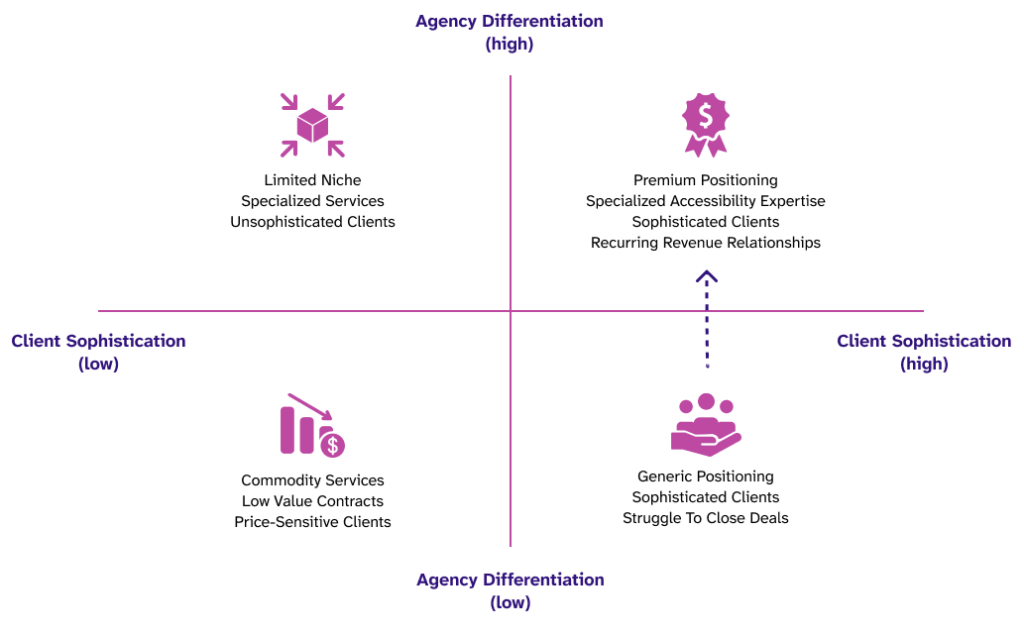
Authority and expertise signals. When prospects evaluate agencies, they’re looking for competence indicators. Accessibility expertise immediately signals technical sophistication because most agencies don’t have it. You’re demonstrating knowledge of legal requirements, understanding of inclusive design principles, familiarity with assistive technologies, and commitment to quality beyond surface aesthetics.
That positioning attracts better clients. Organizations that care about accessibility compliance are typically more sophisticated buyers who understand the value of expertise and aren’t shopping primarily on price.
Differentiation from commodity competitors. When a prospect is comparing five agencies who all promise “beautiful, responsive, fast websites,” you can’t meaningfully differentiate on the standard deliverables. When you’re the only agency discussing accessibility compliance, testing with screen readers, WCAG conformance, and ongoing monitoring, you’ve immediately separated yourself from the commodity conversation.
Better yet, you’re competing on expertise rather than price—which is exactly where you want to be as an agency trying to escape the race to the bottom.
Natural conversation starter for premium services. Accessibility creates opportunities to discuss comprehensive service relationships rather than one-off projects. The conversation naturally evolves from “we’ll build you a site” to “we’ll ensure your entire digital presence maintains compliance over time.”
That opens doors to retainer relationships, consulting engagements, training programs, and strategic partnerships—all at premium pricing because you’re solving ongoing business problems rather than delivering discrete projects.
Government and enterprise market access. Many of your dream clients have accessibility requirements that eliminate non-compliant vendors immediately. Government contracts require WCAG compliance. Enterprise procurement often includes accessibility evaluation criteria. Education institutions face specific accessibility mandates.
Without accessibility expertise, you can’t compete for these opportunities regardless of your other capabilities. With accessibility expertise, you’ve unlocked an entire market segment that values quality, pays appropriate rates, and offers steady project pipelines.
The Revenue Math: How Accessibility Services Transform Agency Economics
Theory is easy. Let’s look at specific numbers that show how accessibility services change your agency’s financial model.
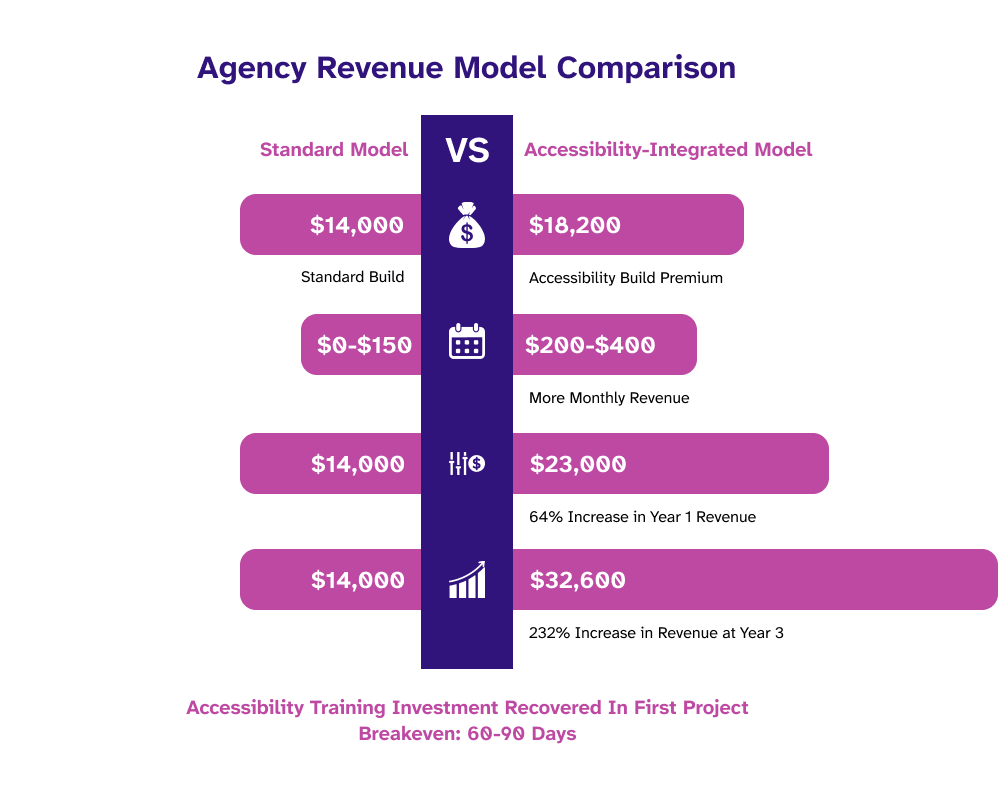
Scenario 1: The Standard Agency Model (No Accessibility Services)
You close a $14,000 WordPress website project. Your fully loaded cost (developer time, project management, design, revisions, hosting setup) runs about $9,000. That’s a $5,000 gross profit, or roughly 36% margin.
After delivery, the client may or may not buy a $150/month maintenance retainer. Industry data suggests about 30% of clients purchase post-launch maintenance. Your expected recurring revenue per project: $540/year ($150 x 12 months x 30% uptake rate).
First-year expected value per project: $14,540 Three-year expected value per project: $15,620
The client relationship effectively ends at launch. You need a constant pipeline of new projects to sustain revenue.
Scenario 2: Accessibility-Integrated Model
Same $14,000 website project, but you build it accessible from the start using scanning tools during development. Your build cost increases modestly (an extra 4-6 hours of developer time for accessibility testing and remediation during the build, roughly $400-$600 in labor).
At launch, you present the client with an accessibility monitoring package. Because you’ve already demonstrated accessibility expertise during the project, and because the client now has a compliance-grade website they need to maintain, uptake rates for accessibility monitoring run significantly higher than generic maintenance retainers.
Based on partner program data from agencies bundling accessibility with managed hosting, close rates on accessibility monitoring packages reach approximately 80% when presented as part of the project delivery. That’s not a typo. When agencies frame accessibility monitoring as the natural continuation of the accessible site they just built, the vast majority of clients say yes.
Monthly accessibility monitoring at $400/month generates $4,800/year in recurring revenue at an 80% close rate: $3,840 expected annual recurring revenue per project.
First-year expected value per project: $17,840 Three-year expected value per project: $25,520
That’s a 63% increase in three-year client value compared to the standard model, and the recurring revenue component means your revenue becomes more predictable and less dependent on constantly closing new projects.
Scenario 3: The Partner Agency Model (Bundled Accessibility at Scale)
Agencies that systematically bundle accessibility into every project see compounding effects. When accessibility is part of your standard offering rather than an upsell, your average project price increases by roughly 40% because you’re selling a different (and more valuable) deliverable.
Instead of competing with five other agencies on a $14,000 website build, you’re proposing a $19,600 accessible website build with ongoing compliance monitoring. In many cases, you’re the only agency in the conversation that even raises accessibility. That eliminates price comparison entirely because there’s nothing to compare against.
The Payback Math for Getting Started
Building accessibility capabilities requires an initial investment: team training, scanning tools, and slower first projects while your developers learn the workflow. Here’s what that investment looks like:
Scanning tools: Professional-grade WordPress accessibility scanning runs $300-$3,000/year depending on the plan and number of sites. At the agency/partner level, per-site costs drop significantly with volume pricing.
Team learning curve: Your first 2-3 accessible projects will take 10-15% longer as developers learn the workflow. By projects 4-5, accessible development becomes standard practice with minimal time overhead.
Breakeven timeline: If accessibility monitoring generates $3,840 in expected annual recurring revenue per project, a single project’s recurring revenue covers your annual scanning tool investment. Everything after that is margin.
Most agencies reach profitability on their accessibility practice within 60-90 days of starting.
The Ongoing Revenue Model: Accessibility Maintenance
Here’s where accessibility transforms your business economics: maintenance becomes necessity rather than optional upgrade.
Consider the typical agency relationship. You build a site, deliver it to the client, maybe offer a support retainer that 30% of clients actually purchase. Most clients launch the site and disappear until they need a redesign years later.
Accessibility changes that dynamic completely.
Continuous monitoring requirements. Websites don’t stay accessible without active maintenance. WordPress core updates, plugin updates, theme changes, and content additions all create accessibility risks. Organizations facing compliance requirements can’t just hope nothing breaks—they need verification.
That creates natural demand for monthly monitoring services. You’re not convincing clients to buy optional peace-of-mind services—you’re offering essential compliance verification.
Practical pricing that works. Accessibility monitoring services can support pricing that makes economic sense for both agencies and clients. Monthly fees ranging from $200-$800 depending on site complexity provide meaningful recurring revenue while remaining accessible to small-to-midsize organizations.
More importantly, these services deliver clear value. Clients receive regular accessibility reports, proactive issue alerts, compliance documentation, and expert support when problems arise. They’re not buying abstract “maintenance”—they’re buying concrete risk mitigation and compliance assurance.
Scalable service delivery. Unlike custom development work that requires significant time per client, accessibility monitoring leverages tools and automation. Your team reviews results, provides expert analysis, and handles remediation—but the initial scanning and reporting can scale efficiently.
That means accessibility monitoring services can maintain healthy margins while supporting competitive pricing. You’re building recurring revenue that doesn’t linearly increase labor costs.
Natural upsell pathway. Accessibility monitoring creates opportunities for additional services. When monitoring identifies issues, clients need remediation. When new pages launch, clients need accessibility review. When legal requirements change, clients need guidance.
Each of these represents additional revenue without awkward sales conversations—you’re responding to documented needs revealed through the monitoring relationship.
The Accessibility Halo Effect: Compound Benefits Beyond Compliance
Here’s what makes accessibility services particularly powerful: accessible websites perform better across multiple dimensions beyond compliance.
Your clients hire you for accessibility compliance, but they also get significantly better SEO performance, improved user experience for all visitors, and enhanced site performance metrics. These compound benefits make accessibility services easier to sell and dramatically improve client satisfaction.
Search engines reward accessible websites. Google’s algorithms increasingly prioritize user experience signals—page speed, mobile usability, clear navigation, readable content. These align directly with accessibility requirements. Semantic HTML structure, descriptive link text, logical heading hierarchy, and clear content organization all serve both accessibility and SEO.
Organizations with large internal content teams notice this immediately. They can handle content creation themselves, but they struggle with technical accessibility and SEO optimization. That creates natural demand for ongoing technical accessibility services even from organizations that typically minimize agency dependence.
The accessibility-SEO connection provides compelling sales messaging. You’re not just helping clients avoid lawsuits—you’re improving their organic search performance, user engagement metrics, and overall site quality. That transforms accessibility from compliance cost to business investment.
User experience improvements benefit everyone. Clear navigation helps all users, not just screen reader users. Sufficient color contrast improves readability in bright sunlight, not just for users with low vision. Keyboard navigation helps power users and people with temporary injuries, not just users with motor disabilities.
These universal benefits mean accessible websites consistently receive better user feedback, lower bounce rates, and higher conversion metrics. Your clients see tangible business results beyond compliance documentation—which makes renewal conversations straightforward.
Performance optimization naturally accompanies accessibility work. Efficient code structure, optimized images, clear hierarchy, and reduced dependency on complex JavaScript all serve both accessibility and site performance. When you’re building with accessibility in mind, you’re typically building faster, cleaner sites.
This creates a virtuous cycle: clients hire you for accessibility compliance, experience improved SEO and user experience, achieve better business results, and naturally expand the relationship. You’re not constantly justifying monthly fees—you’re demonstrating ongoing value across multiple dimensions.
Building Accessibility Into Your Practice: Practical Implementation
This all sounds compelling in theory, but how do you actually build accessibility capabilities without massive investment or years of training?
Start with education and positioning. You don’t need to become a Certified Professional in Accessibility Core Competencies (CPACC) to begin serving clients. Start by educating yourself on WCAG basics, common accessibility barriers in WordPress, and practical testing approaches. Demonstrate this knowledge through content marketing—blog posts, social media, client conversations.
That positions you as the accessibility-aware agency in your market before you’ve delivered a single accessibility project.
Incorporate accessibility into existing projects. Don’t launch a separate accessibility service line immediately. Instead, start building accessibility considerations into your standard development workflow. Include basic accessibility testing in quality assurance. Discuss accessibility in discovery and planning. Deliver sites with better accessibility than competitors by default.
This builds your team’s capabilities incrementally while improving project quality—and creates case studies for dedicated accessibility services.
Leverage accessibility scanning tools strategically. You can’t manually test every accessibility requirement on every client site continuously. Modern accessibility scanning tools—particularly those using virtual browser technology rather than basic code analysis—can identify the majority of issues efficiently.
Choose tools that integrate naturally with WordPress workflows, provide clear remediation guidance, and support ongoing monitoring. Look for solutions designed for agencies rather than enterprises—you need appropriate feature sets at accessible price points.
Develop a scalable service offering. Once you have several projects demonstrating accessibility capabilities, formalize your accessibility service offering. Create clear packages: accessibility audits, remediation services, ongoing monitoring, training programs. Price these services to reflect their compliance value, not their labor cost.
Remember, you’re not billing hourly for accessibility work—you’re pricing based on the business value of compliance assurance and risk mitigation.
Build partnerships for specialized expertise. You don’t need to be the definitive authority on every accessibility nuance. Develop relationships with accessibility consultants for complex questions, legal expertise for compliance guidance, and assistive technology users for user testing. These partnerships let you confidently serve clients while acknowledging the edges of your expertise.
This approach lets you offer comprehensive services without claiming expertise you don’t have—which is both more honest and more sustainable.
The Insi Accelerator: Building Expertise Without Years of Training
The biggest objection to developing accessibility services is typically time investment: “We don’t have accessibility experts on staff, and training the team would take years.”
This reflects outdated assumptions about how agencies build new capabilities.
You don’t need Certified Professional in Accessibility Core Competencies (CPACC) credentials to serve accessibility clients effectively. You need practical WordPress accessibility knowledge, reliable testing tools, and expert support when facing complex questions.
Modern accessibility platforms like Insi provide exactly that foundation. The virtual browser scanning technology identifies accessibility issues that agencies would miss without assistive technology testing expertise. The platform provides clear remediation guidance rather than cryptic WCAG references. And the support team helps navigate complex situations.
This means your team can become genuinely competent in accessibility services within weeks rather than years. You’re not learning to become accessibility consultants—you’re learning to deliver accessible WordPress sites using professional-grade tools that amplify your existing development expertise.
The practical workflow looks like this:
Your developer builds the site following WordPress best practices. Before client review, they run Insi scanning to identify accessibility issues. The platform highlights specific problems—missing alt text, insufficient color contrast, keyboard navigation barriers, form label issues. The developer addresses these issues using Insi’s remediation guidance.
At launch, the site has genuine accessibility rather than just hoping the theme was accessible. Post-launch, monthly scanning ensures plugin updates and content changes don’t introduce new barriers. When issues arise, your team addresses them or escalates complex questions to Insi support.
Your client receives professional accessibility services. Your team builds practical expertise through real projects. And you’re not spending months in training before delivering value.
The compound expertise effect matters long-term. Each project builds your team’s accessibility knowledge. After 5-10 accessible projects, your team has genuine expertise that goes beyond tool-assisted development. You can speak confidently about accessibility in sales conversations, provide strategic guidance to clients, and position as accessibility specialists in your market.
But you’re delivering value and generating revenue from day one rather than investing years in training before launching services.
What We’ve Learned From Building 100+ Accessible WordPress Sites
This article isn’t theoretical advice from people who’ve read about accessibility. It’s drawn from over a decade of building accessible WordPress sites at ArcStone, a Minneapolis web development agency with 28 years of experience, and from building Insi, the accessibility scanning platform that grew out of that practice.
Here’s what we’ve learned that isn’t obvious from the outside:
The biggest accessibility issues aren’t the ones you’d expect. Most agencies assume accessibility is primarily about alt text and color contrast. Those matter, but the issues that create real compliance risk are subtler: form labels that look correct visually but aren’t properly associated in the code, interactive elements that work with a mouse but trap keyboard users, dynamic content that updates without notifying screen readers, and third-party embeds (maps, videos, chat widgets) that introduce barriers outside your direct control.
This is why virtual browser scanning technology matters. Traditional code-only scanners check the HTML source, but many accessibility issues only manifest when the page is actually rendered in a browser, with JavaScript executed, CSS applied, and interactive elements functional. Testing the code alone is like proofreading a script instead of watching the performance.
Agencies underestimate how much accessibility knowledge they already have. If your team builds with semantic HTML, uses proper heading hierarchy, writes descriptive link text, and tests across devices, you’re already doing 60-70% of accessibility work. The gap between “decent web development practices” and “genuinely accessible websites” is narrower than most agencies think. Professional scanning tools close that gap by catching the technical issues that require specialized knowledge.
The overlay conversation is your biggest sales opportunity. When a prospect mentions they “already have an accessibility solution” and it turns out to be an overlay widget, that’s not a lost sale. That’s your opening. Overlay tools don’t fix underlying accessibility issues. They apply a cosmetic layer that can actually make sites harder to use for people with disabilities. Explaining this distinction, backed by the ability to scan their site and show the issues the overlay is hiding, is the single most effective sales conversation in accessibility services.
A DHS Trusted Tester certification, formal WCAG training, or partnerships with accessibility testing organizations strengthen your credibility. But you don’t need them to start. You need reliable scanning tools, honest communication about what you can and can’t do, and the willingness to learn as you go. The agencies that succeed with accessibility are the ones that start imperfect and improve, not the ones that wait until they feel like experts.
The Pricing Psychology Shift
Perhaps the most powerful aspect of accessibility services is how they reframe pricing conversations entirely.
When you’re selling website development as a commodity, clients naturally focus on cost minimization. They’re comparing quotes, negotiating timeline/feature tradeoffs, and asking “can we reduce the price by cutting X?” The entire conversation centers on expense.
When you’re selling accessibility compliance, clients evaluate effectiveness and risk mitigation. They’re asking “will this protect us from lawsuits?” and “will this maintain our government contract eligibility?” and “can we trust your expertise?” Price becomes a secondary consideration after establishing solution credibility.
That psychological shift is everything. You’re no longer defending your pricing against cheaper alternatives—you’re demonstrating your capability to solve a problem that has real consequences.
Better clients respond to this positioning naturally. Organizations sophisticated enough to care about accessibility compliance are typically sophisticated enough to value expertise appropriately. They understand that cutting corners on compliance creates risk. They recognize that ongoing monitoring provides value. They appreciate expert guidance through complex requirements.
These are exactly the clients every agency wants—and accessibility expertise attracts them naturally.
Frequently Asked Questions About Accessibility Services for Agencies
Your Next Move: Three Paths Based on Where You Are Today
The opportunity is clear. The question is what you do this week.
If you’re an agency owner exploring accessibility for the first time: Start by scanning one of your existing client sites with a free accessibility tool. See what comes back. You’ll likely find issues you didn’t know existed, and that experience will make everything in this article concrete rather than theoretical. Insi offers a free demo scan that shows exactly what virtual browser scanning reveals compared to basic code analysis.
If you already know accessibility matters but haven’t formalized it as a service: The 90-day implementation timeline in this article is your roadmap. Pick one upcoming project to build with accessibility integrated from the start. Use professional scanning tools during development, present accessibility monitoring to the client at delivery, and document the results. That single project becomes your case study, your pricing proof point, and your team’s training ground.
If you’re ready to build accessibility into every project and grow a recurring revenue base: Look at Insi’s partner program. The program is designed specifically for agencies, with volume pricing that makes per-site scanning costs drop as your practice grows, dedicated onboarding to integrate accessibility into your existing workflow, and ongoing support when your team encounters complex accessibility questions.
The agencies that will thrive through the next five years of market compression aren’t the ones building websites faster or cheaper. They’re the ones solving problems their competitors don’t address. Accessibility is that problem, the compliance deadlines are real, and the window for early-mover advantage is closing.

David Carnes
David Carnes is CFO of ArcStone, a Minneapolis web development agency he’s helped lead for 28 years, and a strategic advisor to Insi. A four-time company founder with over $50 million in career sales across web services and technology, David focuses on the intersection of compliance, profitability, and sustainable growth. His work with Insi centers on helping agencies transform accessibility from a cost center into a revenue driver through practical service models and partner economics.

Nicholas Longtin
Nicholas Longtin is CEO and co-founder of Insi, the WordPress-native accessibility scanning platform built to close the gap between ineffective overlay tools and unaffordable enterprise solutions. With 26 years of web development experience, a DHS Trusted Tester certification, and a decade focused specifically on WordPress accessibility, Nick built Insi from real-world practice at ArcStone, where he continues to serve as Senior Strategist. He writes about accessible development, compliance strategy, and the business case for inclusive design.